Book Review: The $100 Startup by Chris Guilebeau

I enjoyed this book immensely!  We are often inundated with “self-help” books about starting a business and these books often require either specific skills or a huge amount of money with which to start.  Chris Guilebeau heads in the opposite direction with this book.  Many of the testimonials throughout this book required few skills and very little money.

This is not to say that it is an easy method.  There is a lot of sweat equity involved.  Guilebeau likes to call it hustle.  He shares methods throughout the book that will help a micropreuner to be successful.  A micropreuner is a person that creates a business with the intention of replacing a job and providing a better life.  The micropreuner does not intend to hire employees.

Guilebeau goes through startup after startup, sharing the successes and the challenges of micro-startups.  This do-this-but-not-that approach is helpful beyond belief.  The book highlights what seems to be becoming “a new economy” which is not only exciting but definitely needed as life changes but many businesses do not.

In essence, if you are looking at starting a new business or to bounce back from an unfortunate professional situation, it would be well worth your time to check out The $100 Startup.  There are new ideas and the opportunity to acquire new skills.

Book Review: The Subtle Art of Not Giving a F*ck.

Not everyone responds to the same voice.  Why else would we have 100s of books that are on roughly the same topic?  I was unsure as to whether or not to review this book.  The title itself is enough to put most people off.  The title is quite sensationalized but the meat of the book is strong.

The initial idea behind the book is not what the title would suggest.  To think that one would not care about anything, as the author states, is a psychopath and not a well-rounded person.  The overarching point of the book is that we often burn an inordinate amount of energy dealing with issues that are not nearly as important as we create them to be in our minds.  Instead of celebrating our successes, we measure ourselves by the defeats that we give huge power over ourselves.  We often hear people talk about “first world problems”, usually followed by nervous laughter.  We live in a comparative society and often create situations that we have no possible chance of keeping up with those particular Joneses.

The book is graphic as if the title did not give that subtle fact.  The author cloaks very serious issue in irreverent language and examples creating a palatable read for many people.   All and all, this book feels a voice that many people would find to be easier to deal with than a heavy book about psychology.  I enjoyed to book and I hope that you do as well.

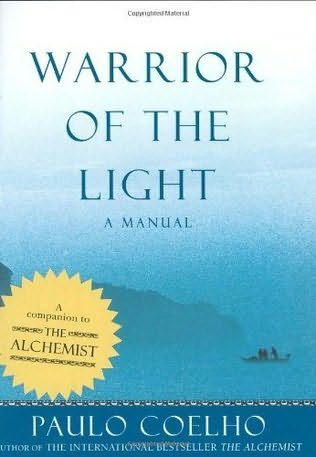
Book Review: Warrior of the Light by Paulo Coelho

Let me begin with some fanboy adoration, Paulo Coelho is one of my favorite all-time writers.  The reason that I like Coelho is that his writing can be as simple or as complex as you are willing to go.  A person could read nearly any of his works in an evening but, if that person was willing to consider the work more deeply, these works could be studied for weeks or months.  Another genre that is capable of such a span is fairie tales.

Warrior of the Light is a list of beliefs and decisions made by the people who identify as Warriors of Light.  The list is told in a parable form and the parables are quite enjoyable to be read.  The parables are enjoyable and easily understood at a base level.  The defining of a Warrior of Light is the entire plot of the book.  Warriors of Light have a fluid definition and can be useful to nearly everyone.

The beautiful thing about Warriors of Light is that the reader can accept what he or she needs and reject what does not apply.  This is not an all or nothing list.  Take what you need, reject the rest.  My best recommendation is to take the time to reflect on the words being written.  Consider your feelings on each section and make use of that which is useful.

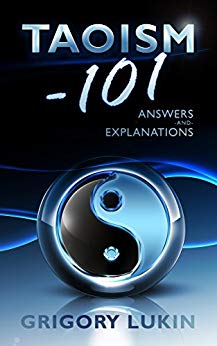
Book Review: Taoism-101 by Grigory Lukin

Taoism-101 is a very short read that gives the most basic of overviews of Taoism.  One thing that I enjoyed about the book is that the author gave plain information without attempting to sway the reader in one way or another.  There has been a long-running discussion as to whether Taoism is a religion or a philosophy.  In my opinion, either could be correct as Tao is flexible enough to be whatever the practitioner needs.

There are a large number of similarities between religions and philosophies.  Both attempt to act as a moral guide for the follower.  They give signposts about acceptable and unacceptable behavior and actions.  The biggest difference is that religions offer a reward or punishment at the end of life while a philosophy avoids making such assertions.

The author of the book is very clear to disseminate in his answers whether or not he is answering from the religious or the philosophical side of Taoism.  It is extremely important that he makes that distinction because the answers could change based on the form of Taoism being considered.

The author does an excellent job answering simple questions as they relate to Taoism,  He writes in clear and concise language that gives the reader an answer that is not vague or jargon-filled.  As the title of the book states, this is an entry-level book designed to clarify the beginning question.  In this, the author excelled.

Book Review: Fighting the Inside Dragons by Bogden Ignat

I discovered this book on this post and was immediately moved to acquire it and read it as quickly as possible.  I devoured the entire book in an evening.  Let me begin by saying that this is not a Kumbaya book.  There are hard lessons involved and they are plainly stated.  That is one of the many things that I loved about this book.  Some of us require that “tough love” or to be “hit over the head with the point”.  I know that I do.  The author found a way to deliver that tough love without malice.  That is a spot that is difficult to hit when writing.

There are so many positives to hit regarding this book, I am almost certain that I am going to do a disservice by leaving some of them out.  One of the best points is how misery loves company.  Ignat says, “Most of us can’t wait to find someone that is willing to talk about crappy things with us.”  This is so accurate that it is borderline scary.  If we spent nearly as much time talking about the good things in life instead of the bad, how much different would our lives be.  Often we don’t even realize how much time we spend discussing the negativity of life.  With the 24/7 news cycle and the looming specter of social media, we don’t even have to look far for the crappy things and a person to compare tragedies with.

I love the way that the neural network is described.  So simple, so accurate,  Each time we perform an action that is a habit, we further reinforce that habit.  It is a vicious circle.  Each time we embrace that habit, the path becomes a little wider and a little smoother.

As much as I loved the book, there were a few issues.  Sometimes the wording of a point caused me to go back and reread a passage several times.  While that is inconvenient, I believe that the reinforcement of several readings helped to highlight the message the author intended.  Ironically, the author mentions several times that his writing style is unusual; however, he embraces it and it works for him.

The book is raw and that is a good thing.  Everyone doesn’t respond to the literary version of frolicking in the fields.  Thank you, Bogden.  This book was well worth the time that you invested.  Congratulations.

Book Review: Buddha In Blue Jeans by Tai Sheridan

Buddha in Blue Jeans by Tai Sheridan is beautiful in its simplicity.  When I first began my journey, this is one of the first books that I acquired through Kindle.  The book was written in 2011 and extolls the virtues of sitting quietly.  Yes, I know, I know, sitting quietly is not one of the most exciting topics that one can cover; however, a person can learn a lot about him or her self and the world in general by sitting quietly.

This book is an extremely short read as one can finish it easily within an hour but there are timeless subjects that are covered throughout the pages.  One could easily make a study of this book over weeks and months by simply pursuing the ideas that Sheridan covers.  There are fifteen topics that are covered in the book that range from Care for Your Body to Love Indiscriminately.

One of my favorite passages in Buddha in Blue Jeans is “Pain is Natural”.  I found this to be beautiful because we are in an “instant relief” based society.  There is a pill for everything that ails a person and several pills that counteracts the side effects for the first pill, creating a balancing act.  Please don’t misunderstand, I am not advocating for a person to be in continuous, agonizing pain; however, a little pain is normal.  Pain is a message to the brain that tells us to be careful.

Is Buddha in Blue Jeans going to answer every question that a person might have on the voyage to enlightenment?  Of course not, but it will smooth out the first few steps along the way.  I fully recommend Buddha in Blue Jeans to those that are just beginning their life-changing journey.  I also recommend the book for a gentle read to reinforce many things that experienced seekers know to be true.

Buddha in Blue Jeans is available on the Amazon Kindle app for free.  You can get your copy here.

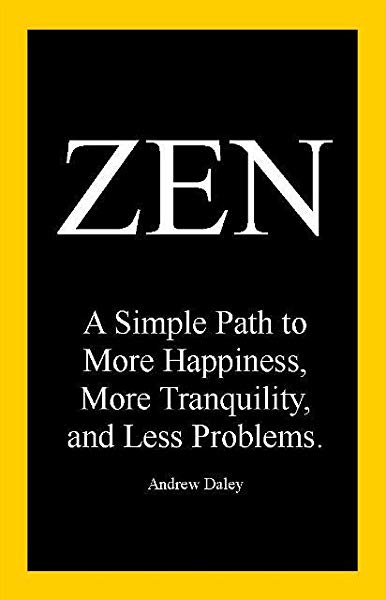
Book Review: Zen by Andrew Daley

The full title of this book is Zen: A Simple Path to More Happiness, More Tranquility, and Less Problems.  I Just could not figure out a way to put all of that in the title of my post and still have the title draw the eye in a positive way.

This is a short book, coming in at under 200 pages, which I honestly find to be a selling point.  I often find that books are longer than they need to be because the author belabors the point.  I am not a “lazy reader” but I think that the length of the book should be dictated by the message that is being conveyed.  This book hit that “sweet spot” of giving enough information but not making the reader feel as if he or she is being beaten about the head with the information.

stack_of_books

Philosophy has always been interesting to me and Eastern Philosophy is doubly so.  The issue that I have with most books is that the authors use vague terminology (without definitions) about which most laymen have no idea.  This book does not have this issue.  The book is simply written with vivid, imaginative description to allow the reader to better understand the concept.

All in all, it was a very enjoyable book that I read in one sitting.  This book is not going to convince you to change your life; however, if you have decided to make a change, this book offers tips and methods that will help you with the change.